
The Bible is filled with meaningful words and powerful messages that can deepen our understanding of faith, love, and our relationship with God.
If you have come across the word “assayed” while reading Scripture, you may wonder what it means and why it is used in the Bible. The assayed meaning in the Bible generally relates to being tested, examined, tried, or proven, especially in the context of faith and character.
Understanding this biblical word can help you appreciate the deeper message behind certain passages and discover how spiritual tests can shape, strengthen, and reveal a person’s faith in God.
What Does “Assayed” Mean in Everyday Language and in Scripture?
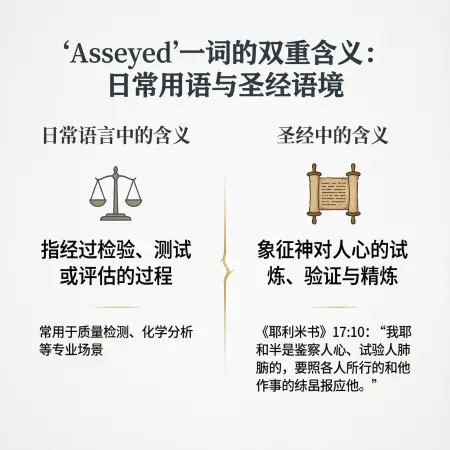
In modern English the verb “assay” most often refers to testing the purity of metals.especially gold or silver.through chemical analysis. The older sense, however, simply means “to try,” “to attempt,” or “to put to the test.” That older sense is exactly what the King James translators captured when they chose “assayed.”
The assayed meaning in the bible therefore centers on three overlapping ideas:
- Making an attempt or endeavor (sometimes successful, sometimes not)
- Testing or proving something or someone
- Examining quality, fitness, or genuineness
These ideas appear both in the Old Testament (Hebrew) and the New Testament (Greek). The main Hebrew root is nāsāh (Strong’s H5254), which means to test, try, prove, or tempt. Another Hebrew verb, yā’al, can also stand behind the word in certain contexts. In the Greek New Testament the verbs peirazō and peiraomai carry the sense of attempting or testing.
Because the King James Version was completed in 1611, its vocabulary preserves these older English shades of meaning that newer translations often replace with “tried,” “attempted,” or “endeavored.” Understanding the original wording helps us hear the text the way earlier generations of English-speaking believers heard it.
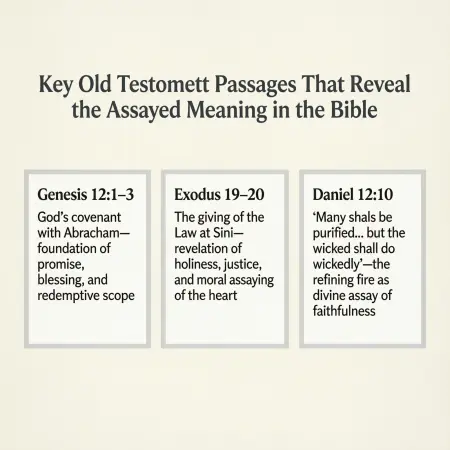
Key Old Testament Passages That Reveal the Assayed Meaning in the Bible
Deuteronomy 4:34 – God Assayed to Take a Nation
One of the clearest uses appears in Moses’ address to Israel:
“Or hath God assayed to go and take him a nation from the midst of another nation, by temptations, by signs, and by wonders, and by war, and by a mighty hand, and by a stretched out arm, and by great terrors, according to all that the LORD your God did for you in Egypt before your eyes?” (Deuteronomy 4:34, KJV)
Here the assayed meaning in the bible is “attempted” or “ventured.” Moses asks a rhetorical question: Has any other god ever even tried to extract an entire people from the middle of a powerful empire the way the Lord did with Israel? The answer is obviously no. The word underscores the unprecedented nature of the Exodus. God did not merely rescue; He assayed.He deliberately set out.to accomplish something no other deity had attempted.
The verse lists seven means God used: temptations (tests or trials), signs, wonders, war, a mighty hand, an outstretched arm, and great terrors. Each element reinforces that the deliverance was both planned and executed with divine power. For modern readers the passage invites us to remember that God’s saving acts are never accidental; they are purposeful attempts that succeed because He is God.
1 Samuel 17:39 – David Assayed to Wear Saul’s Armor
The story of David and Goliath contains another vivid example:
Young David tried on King Saul’s armor and “assayed to go”.he attempted to walk and move in it. Because he had never tested or practiced with that kind of equipment, he quickly realized it would hinder rather than help him. He laid the armor aside and went out with the weapons he knew: a shepherd’s staff, a sling, and five smooth stones.
In this scene the assayed meaning in the bible highlights both an attempt and a test of fitness. David’s willingness to try the armor shows humility and respect for the king, yet his decision to reject it shows wisdom and dependence on the Lord rather than human resources. The episode teaches that not every well-intentioned attempt is the right one; sometimes the test itself reveals that a different path is needed.
Other Old Testament Echoes
While the exact English word “assayed” is rare, the underlying Hebrew idea of testing appears throughout the Old Testament. God tests Abraham (Genesis 22), Israel in the wilderness (Deuteronomy 8:2), and Hezekiah (2 Chronicles 32:31). Each instance carries the sense of proving what is in the heart.exactly the spirit behind the assayed language.
New Testament Uses of Assayed
Acts 9:26 – Saul Assayed to Join the Disciples
After his dramatic conversion, Saul of Tarsus (later Paul) arrived in Jerusalem:
“And when Saul was come to Jerusalem, he assayed to join himself to the disciples: but they were all afraid of him, and believed not that he was a disciple.” (Acts 9:26, KJV)
Here “assayed” means “attempted” or “tried.” Saul made a genuine effort to connect with the believers, yet fear and distrust blocked the way until Barnabas intervened. The verse reminds us that even sincere attempts can meet resistance, and that God often uses intermediaries to open doors.
Acts 16:7 – Paul and Companions Assayed to Enter Bithynia
During the second missionary journey we read:
“After they were come to Mysia, they assayed to go into Bithynia: but the Spirit suffered them not.” (Acts 16:7, KJV)
Paul’s team planned and attempted to preach in Bithynia, but the Holy Spirit redirected them. The assayed meaning in the bible here shows human planning meeting divine guidance. Their attempt was not sinful; it was simply not God’s timing or direction. The redirection led to the Macedonian call and the gospel’s entrance into Europe.an outcome far greater than the original plan.
Acts 24:6 and Hebrews 11:29
In Acts 24:6 Paul is accused of having “assayed” (attempted) to profane the temple. In Hebrews 11:29 the Egyptians “assayed” to cross the Red Sea and were drowned. Both uses underscore unsuccessful or misguided attempts, reinforcing that not every human endeavor succeeds when it opposes God’s purpose.
Connecting Assayed to Pele’ – The Meaning of Wonder in the Bible
The second half of the keyword phrase points toward pele’ (Hebrew פֶּלֶא, Strong’s H6382), often translated “wonder,” “marvel,” or “wonderful.” While “pel” is not a standard English Bible word, pele’ is the root behind many descriptions of God’s miraculous acts.
Key appearances include:
- Exodus 15:11 – “Who is like unto thee, O LORD, among the gods? who is like thee, glorious in holiness, fearful in praises, doing wonders (pele’)?”
- Isaiah 9:6 – The Messiah is called “Wonderful (pele’), Counsellor…”
- Psalm 77:11, 14; 88:10, 12; 89:5 – Repeated celebrations of God’s wonders
- Psalm 119:129 – “Thy testimonies are wonderful (pele’)”
Pele’ describes that which is extraordinary, beyond ordinary human understanding, and characteristic of God’s redemptive and judgment acts. When we place the assayed meaning in the bible beside pele’, a beautiful pattern emerges: human beings assay (attempt and are tested), while God performs pele’ (wonders that surpass all human effort).
David assayed Saul’s armor and failed; God performed a wonder through a sling and a stone. Israel was tested in Egypt; God assayed to deliver them and accomplished wonders. Paul assayed to go to Bithynia; the Spirit redirected him toward a greater wonder.the spread of the gospel into new continents.
Spiritual Lessons from the Assayed Meaning in the Bible
1. Attempts Reveal the Heart
Every time someone in Scripture assays something, the attempt exposes motives, readiness, or dependence on God. David’s trial of the armor showed he was not relying on royal prestige. Saul’s attempt to join the disciples revealed the depth of residual fear among the believers. Our own attempts.whether in ministry, relationships, or personal growth.likewise function as tests that uncover what is truly inside us.
2. Not Every Attempt Succeeds.and That Is Okay
Several biblical assays end in failure or redirection. That does not mean the attempt was wasted. Failed assays often become the doorway to better paths. Paul’s blocked journey to Bithynia produced the Macedonian vision. David’s rejection of the armor produced a victory that glorified God alone. Learning to hold our plans loosely is part of mature faith.
3. God Assays His People for Refinement
Scripture frequently portrays God as the One who tests. Proverbs 17:3 says, “The fining pot is for silver, and the furnace for gold: but the LORD trieth the hearts.” The same Hebrew root behind “assayed” appears in many of these testing passages. Trials are not random; they are divine assays designed to purify faith the way a metallurgist assays and refines precious metal (1 Peter 1:6-7).
4. Human Assay Meets Divine Wonder
When our limited attempts meet God’s pele’, the result is testimony. The Exodus, the defeat of Goliath, the conversion of Saul, and the missionary journeys all illustrate this intersection. Our role is to assay faithfully; God’s role is to perform wonders.
Practical Ways to Apply These Truths Today
- Examine your current attempts. What are you “assaying” right now. a new job, a ministry idea, a relationship, a habit change? Ask whether you have “proved” the approach the way David proved (or rather, had not proved) the armor.
- Invite the Spirit’s redirection. Paul’s team was sensitive enough to recognize when the Spirit said no. Cultivate the same sensitivity through prayer and Scripture.
- View trials as assays. Instead of asking only “Why is this happening?” ask “What is God proving or refining in me through this test?”
- Celebrate the wonders. Keep a record of pele’ moments.answers to prayer, unexpected provisions, changed hearts.so that your faith is continually strengthened by remembrance.
- Study the original languages. Even a basic concordance or interlinear Bible can open deeper layers of meaning behind words like assayed and pele’.
Common Misunderstandings to Avoid
Some readers assume “assayed” always means a successful test. The biblical record shows both successful and unsuccessful assays. Others treat every difficulty as a divine assay of faith; while God does use trials, not every hardship is a deliberate test. Wisdom and community counsel help us discern the difference. Finally, do not confuse the archaic English “assay” with the modern scientific term; the biblical sense is broader and more relational.
FAQ Section: Assayed Meaning in the Bible and Related Questions
1. How many times does the word “assayed” appear in the King James Bible?
It appears a handful of times as “assayed,” “assay,” or “assaying,” primarily in Deuteronomy 4:34, 1 Samuel 17:39, Acts 9:26, Acts 16:7, Acts 24:6, and Hebrews 11:29. The underlying Hebrew and Greek ideas of testing appear far more frequently.
2. Is “assayed” the same as “tempted”?
The Hebrew nāsāh can be translated both ways depending on context. When God is the subject, it usually means “tested” rather than “tempted to evil.” When humans are the subject, it often means “attempted.”
3. What is the difference between assayed and proved in 1 Samuel 17:39?
“Assayed” describes David’s attempt to walk in the armor; “proved” (also from nāsāh) describes the prior testing or experience he lacked. He tried it because he had never tested it before.
4. Does the New Testament still use the idea of assaying even if the English word is rare in modern translations?
Yes. Modern versions usually render the Greek verbs as “tried,” “attempted,” or “endeavored,” but the concept of testing faith and seeking God’s direction remains central (James 1:2-4; 1 Peter 1:6-7).
5. How does pele’ (wonder) relate to the assayed meaning in the bible?
Pele’ describes God’s extraordinary acts that surpass human ability. Human assays are limited attempts; divine pele’ are the wonders that accomplish what no human effort could achieve.
6. Can believers today “assay” something in a biblical sense?
Absolutely. Planning, trying new approaches in service, testing ideas against Scripture, and stepping out in faith are all modern equivalents of biblical assaying.provided we remain open to the Spirit’s guidance.
7. Why do older English Bibles use words like “assayed” that feel unfamiliar today?
The King James translators worked with the English of their era. Words shift meaning over centuries. Studying the original languages and consulting reliable commentaries restores the intended sense and enriches modern reading.
Conclusion: Living in the Light of Assayed Meaning in the Bible and Divine Wonders
The assayed meaning in the bible is far more than an archaic vocabulary lesson. It reveals a God who invites His people to attempt great things, who tests hearts for purity, and who redirects plans according to His higher purposes. At the same time, the related concept of pele’ reminds us that the final outcome rests not on the success of our assays but on the wonder-working power of God.
From Moses celebrating the unprecedented deliverance of Israel, to David laying aside untested armor, to Paul accepting a closed door in Bithynia, Scripture consistently pairs human effort with divine sovereignty. When we assay.when we try, test, and step forward.we do so in the confidence that the God who performs wonders is guiding the process.
May every attempt you make be offered in humility, every test faced with faith, and every wonder received with grateful praise. The same Lord who assayed to redeem a nation and who is called Wonderful still works in the lives of those who trust Him today.

I am Daniel Brooks, a passionate Christian writer and Bible researcher dedicated to sharing faith-based knowledge with readers around the world. I enjoy exploring biblical teachings, dream meanings, Christian living, and spiritual growth through well-researched and easy-to-understand articles.