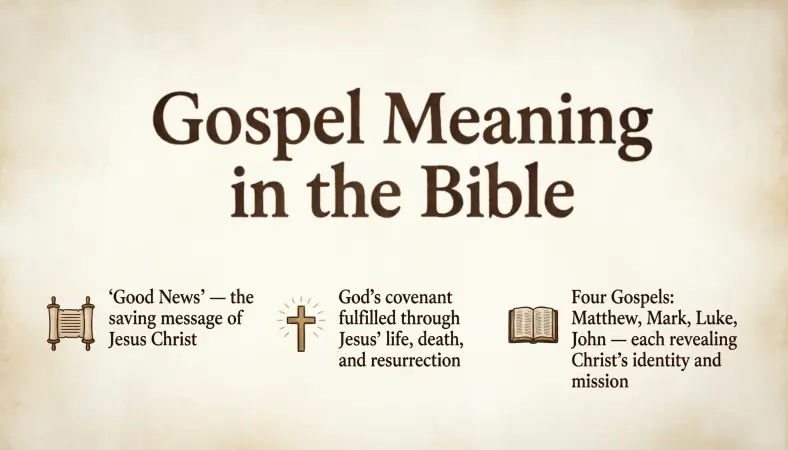
The word “gospel” is one of the most important words in the Bible, carrying a message of hope, salvation, love, and new life through Jesus Christ. But what does gospel actually mean in the Bible, and why is its message so important to Christians?
The term “gospel” means “good news,” referring to the good news that Jesus Christ came into the world, died for humanity’s sins, and rose again, offering forgiveness and eternal life to those who believe in Him.
Understanding the gospel meaning in the Bible can help you see the central message of Scripture more clearly and discover why this powerful message continues to bring faith, comfort, and hope to millions of people around the world.
What Does Gospel Mean in the Bible
At its simplest, the gospel meaning in the bible is “good news.” The English word “gospel” comes from the Old English “godspel,” which itself translates the Greek word euangelion. Euangelion is a compound of eu (good) and angelion (message or announcement). In the ancient world, a euangelion was often a public proclamation of victory, the birth of a ruler, or some other joyful event that affected an entire community.
In the Bible, this “good news” is not generic positivity. It is a specific announcement about what God has done through Jesus Christ. The apostle Paul summarizes it clearly in 1 Corinthians 15:3-4: Christ died for our sins according to the Scriptures, He was buried, and He was raised on the third day according to the Scriptures. That is the heart of the gospel.
Yet the gospel meaning in the Bible stretches beyond a single verse. It includes the entire story of God’s plan to rescue humanity from sin and restore relationship with Him. From Genesis to Revelation, the Bible presents this good news in progressive revelation.hinted at in the Old Testament, fully revealed in the person and work of Jesus, and proclaimed by the early church.
The Greek and Hebrew Roots of the Gospel
Understanding the original languages helps us grasp the gospel meaning in the Bible more accurately.
Greek Background
In classical Greek and later Hellenistic usage, euangelion carried political and cultural weight. When a new emperor was born or a military victory occurred, heralds would announce the euangelion. The message brought relief, hope, and a call to respond.often with allegiance or celebration.
The New Testament writers deliberately used this charged word. By calling the message of Jesus the gospel, they were saying that a greater King had come and a greater victory had been won.over sin, death, and the powers of darkness.
Hebrew Connections
Although the Old Testament was written primarily in Hebrew, the concept of good news appears frequently. The Hebrew word basar (or its related forms) means to announce glad tidings. Isaiah 52:7 is a classic example: “How beautiful upon the mountains are the feet of him who brings good news, who publishes peace, who brings good news of happiness, who publishes salvation.”
The Greek translators of the Septuagint (the Greek Old Testament) often rendered these “good news” passages with forms of euangelion. This created a direct linguistic bridge between the prophetic hope of Israel and the New Testament proclamation of Jesus.
The Gospel in the Old Testament
Many readers assume the gospel begins with Matthew. In reality, the gospel meaning in the Bible is rooted in the Old Testament. God began announcing good news long before Jesus walked the earth.
Early Promises
In Genesis 3:15, after the fall, God promises that the offspring of the woman will crush the serpent’s head. This first gospel promise (sometimes called the protoevangelium) points forward to a coming Redeemer who will defeat evil.
The covenant with Abraham in Genesis 12 includes the promise that through his descendants all nations of the earth will be blessed. Paul later identifies this as the gospel preached beforehand to Abraham (Galatians 3:8).
The Exodus as a Pattern
The deliverance of Israel from Egypt is a powerful picture of the gospel. God rescues His people from slavery through the blood of the Passover lamb, leads them through the waters, and brings them into covenant relationship. New Testament writers repeatedly see the Exodus as a foreshadowing of the greater rescue accomplished by Christ.
Prophetic Hope
Isaiah is especially rich in gospel language. Isaiah 40:9, 52:7, 61:1, and many other passages speak of announcing good news to the poor, binding up the brokenhearted, and proclaiming liberty to captives. Jesus Himself quoted Isaiah 61 in the synagogue at Nazareth and declared, “Today this Scripture has been fulfilled in your hearing” (Luke 4:21).
The Old Testament therefore does not merely prepare for the gospel; it contains the gospel in seed form.promises of a coming King, a suffering Servant, a new covenant, and the outpouring of the Spirit.
The Gospel in the New Testament
When we turn to the New Testament, the gospel meaning in the Bible comes into full focus.
Jesus’ Own Proclamation
Jesus began His public ministry with a clear announcement: “The time is fulfilled, and the kingdom of God is at hand; repent and believe in the gospel” (Mark 1:15). For Jesus, the gospel was the arrival of God’s reign through His own person and work. He healed the sick, cast out demons, welcomed sinners, and taught with authority.all signs that the long-awaited good news was unfolding.
The Apostolic Message
After the resurrection and the coming of the Holy Spirit at Pentecost, the apostles preached the gospel with boldness. Peter’s sermon in Acts 2 centers on Jesus’ death, resurrection, and exaltation, calling hearers to repent and be baptized. Paul’s letters repeatedly return to the same core: salvation by grace through faith in Christ, apart from works of the law.
The New Testament uses “gospel” in several related ways:
- The message itself (Romans 1:16)
- The books that record the life of Jesus (later called the four Gospels)
- The ongoing proclamation of that message by the church
The Four Gospels: Matthew, Mark, Luke, and John
The first four books of the New Testament are called Gospels because they present the good news of Jesus from four complementary angles.
Matthew
Written primarily for a Jewish audience, Matthew emphasizes Jesus as the promised Messiah and King. It contains extensive teaching (the Sermon on the Mount) and many Old Testament fulfillment quotations. Matthew shows that Jesus is the son of David and the son of Abraham who brings the kingdom of heaven.
Mark
The shortest and most action-oriented Gospel, Mark presents Jesus as the suffering Servant and the Son of God. It moves quickly from one event to another, highlighting Jesus’ authority over nature, demons, disease, and death. Mark’s Gospel is especially useful for readers who want a fast-paced introduction to Jesus’ life and mission.
Luke
Luke writes an orderly account for a broader (Gentile-inclusive) audience. He emphasizes Jesus’ compassion for the marginalized.women, the poor, tax collectors, and sinners. Luke also stresses the role of the Holy Spirit and the universal scope of the gospel. The companion volume, Acts, continues the story of the gospel’s spread.
John
John’s Gospel is more theological and reflective. It focuses on Jesus’ identity as the eternal Word made flesh, the Son who reveals the Father. The famous “I am” statements and the extended discourses help readers understand who Jesus is and why faith in Him brings eternal life. John’s purpose statement is clear: “These are written so that you may believe that Jesus is the Christ, the Son of God, and that by believing you may have life in his name” (John 20:31).
Together, the four Gospels give a full-orbed portrait of the same good news. They are not competing biographies but complementary witnesses to the life, death, and resurrection of Jesus.
Core Elements of the Gospel Message
To understand the gospel meaning in the Bible fully, we need to grasp its essential content. While the presentation may vary, the core remains consistent.
- God is holy and Creator. He made the world good and rules it with justice and love.
- Humanity is sinful and separated. Every person has turned away from God and stands under judgment.
- Jesus is the solution. Fully God and fully man, He lived a perfect life, died as a substitute for sinners, and rose victorious over death.
- Salvation is by grace through faith. We cannot earn forgiveness; we receive it as a free gift by trusting in Christ.
- The response is repentance and faith. Turning from sin and trusting Jesus leads to new life, the indwelling Spirit, and the hope of resurrection.
- The result is reconciliation and new creation. Believers are adopted into God’s family and will one day live in a restored creation.
These elements appear throughout the New Testament epistles and the preaching in Acts. They form the non-negotiable heart of the gospel.
Why the Gospel Meaning in the Bible Matters Today
Understanding the gospel is not merely an academic exercise. It shapes how we live, relate to others, and face suffering.
Personal Transformation
The gospel addresses the deepest human needs.guilt, shame, fear of death, and longing for purpose. When someone truly grasps that they are fully known and fully loved because of Christ, it produces lasting change. Anxiety decreases, gratitude grows, and the power of habitual sin begins to loosen.
Motivation for Mission
If the gospel is true, then every person needs to hear it. The early church risked persecution because they believed the good news was too important to keep private. The same conviction drives global mission, local evangelism, and everyday conversations today.
Framework for Ethics
The gospel does not merely tell us what to do; it tells us who we are. Because we are already accepted in Christ, we obey out of love rather than fear of rejection. This grace-based ethic produces freedom rather than legalism.
Hope in Suffering
Life is full of pain. The gospel does not deny suffering; it places it within a larger story. Jesus Himself suffered, and He promises to be with His people in their trials. The resurrection guarantees that suffering is temporary and that justice and healing will ultimately prevail.
Common Misunderstandings About the Gospel
Even sincere people can distort the gospel meaning in the Bible. Here are a few frequent errors:
- Reducing it to moral improvement. The gospel is not primarily advice for better living; it is news of what God has done.
- Making it only about going to heaven. Eternal life begins now and includes transformation in the present age.
- Adding human works as a requirement for acceptance. Salvation is by grace alone through faith alone in Christ alone.
- Treating it as one message among many. The New Testament presents the gospel of Jesus as the unique way of salvation.
- Confusing the gospel with the benefits of the gospel. Peace, joy, and community are results of the gospel, not the gospel itself.
Clearing away these misunderstandings helps us return to the pure, powerful message of Scripture.
Practical Ways to Live Out and Share the Gospel
Knowing the gospel meaning in the Bible should lead to action. Here are practical steps:
- Read the four Gospels regularly. Choose one and read it slowly, noting what Jesus says and does.
- Memorize key gospel passages. Romans 3:23-24, 5:8, 6:23, and 10:9-10 are excellent starting points.
- Practice explaining the gospel simply. Can you share the core message in two or three minutes without Christian jargon?
- Connect the gospel to everyday conversations. When someone mentions guilt, fear, or purpose, the gospel has something to say.
- Live as a gospel community. The local church is meant to display the reconciling power of the good news through love, forgiveness, and mutual care.
- Pray for opportunities and boldness. The early believers prayed for boldness (Acts 4:29-31), and God answered.
Tips for Studying the Gospel Meaning in the Bible More Deeply
If you want to go further:
- Compare the same story across the four Gospels (for example, the feeding of the five thousand or the crucifixion accounts). Notice the unique emphases.
- Trace a single theme.kingdom, forgiveness, or the Holy Spirit.through Matthew, Mark, Luke, and John.
- Read a reliable commentary or study Bible notes on key gospel passages.
- Discuss what you learn with others. Conversation often sharpens understanding.
- Ask the Holy Spirit for illumination. Jesus promised that the Spirit would guide believers into all truth (John 16:13).
Real-Life Impact: Stories of the Gospel at Work
Throughout history and in the present day, the gospel has produced remarkable change. A hardened criminal hears the message of forgiveness and begins a new life. A person crushed by shame discovers they are accepted in Christ and finds freedom. Communities torn by racial or social division experience reconciliation because the cross levels every barrier.
These are not rare exceptions. They are the normal fruit of the good news when it is believed and applied. The same gospel that transformed the first-century Mediterranean world continues to transform lives today.
Frequently Asked Questions About the Gospel Meaning in the Bible
1. What is the simplest definition of the gospel in the Bible?
The gospel is the good news that Jesus Christ, the Son of God, died for our sins, was buried, and rose again so that anyone who trusts in Him receives forgiveness and eternal life.
2. Is the gospel only found in the New Testament?
No. The Old Testament contains many promises and pictures of the good news that find their fulfillment in Jesus.
3. Why are there four Gospels instead of one?
Each Gospel writer addresses different audiences and emphasizes complementary aspects of Jesus’ identity and mission, giving a fuller picture.
4. How is the gospel different from the law?
The law reveals God’s standard and our failure to meet it. The gospel announces what God has done to save us through Christ.
5. Can someone be saved without understanding every detail of the gospel?
Salvation requires genuine faith in the person and finished work of Jesus. Full theological precision is not required at the moment of conversion, but growth in understanding should follow.
6. Why does the Bible call the gospel “the power of God”?
Because the message itself, when believed, is the means God uses to bring about new birth, forgiveness, and transformation (Romans 1:16).
7. How should the gospel affect daily Christian living?
It should produce humility, gratitude, love for others, resistance to sin, and confident hope.even in hardship.because our standing with God rests on Christ rather than our performance.
Conclusion
The gospel meaning in the bible is far richer than a single definition. It is the announcement of God’s victory through Jesus Christ.the good news that sinners can be forgiven, the broken can be healed, and the estranged can be brought home. From the first promise in Genesis to the final vision of a new heaven and new earth in Revelation, the Bible tells one coherent story of redemption.
Understanding this gospel does more than satisfy curiosity. It reorients our identity, fuels our mission, and anchors our hope. As you continue to read Scripture, keep returning to the central question: What is the good news God is announcing here, and how does it point to Jesus?
May the gospel of Jesus Christ become clearer, more precious, and more powerful in your life. The same good news that has transformed countless lives across the centuries is still true, still available, and still able to change everything.

I am Daniel Brooks, a passionate Christian writer and Bible researcher dedicated to sharing faith-based knowledge with readers around the world. I enjoy exploring biblical teachings, dream meanings, Christian living, and spiritual growth through well-researched and easy-to-understand articles.